AI for science, built by a scientist.

I understand complicated systems, find the real problem, and build things.

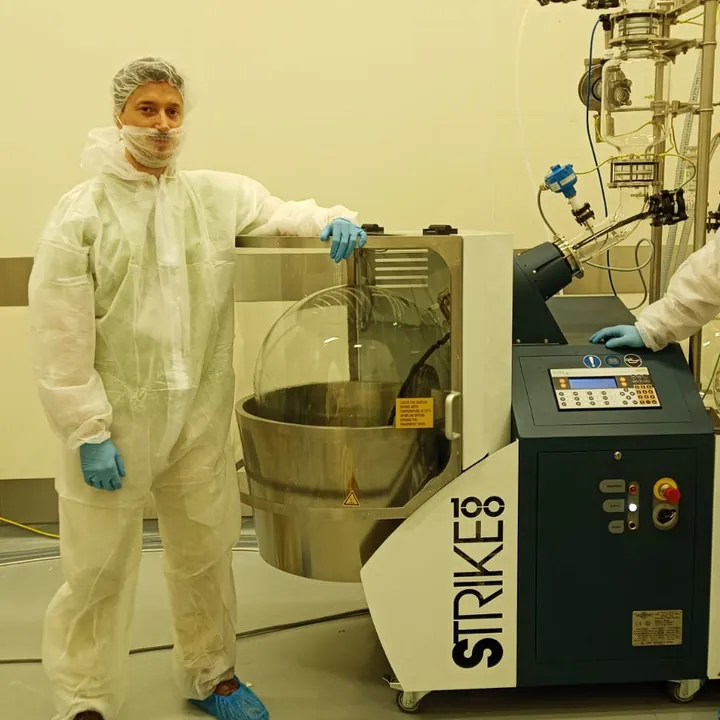
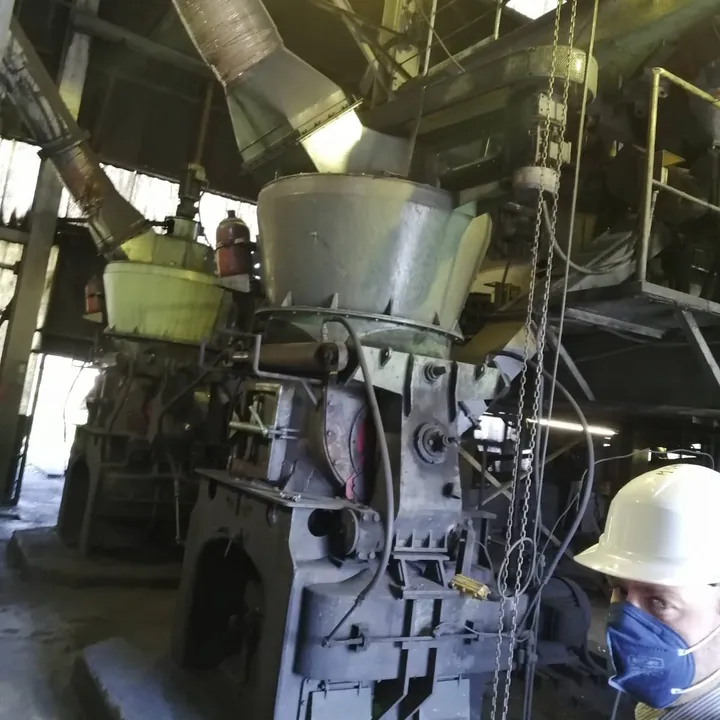
PhD chemist. Three years inside pharmaceutical and industrial labs, installing instruments and building QC facilities. Since 2024, building AI agents and spatial software for the people who work there.

Thessaloniki, GreeceBuilding Varlis · Alepou

Featured
Built by asking: the balance test, recorded at 1:34

AI for science in mixed reality

Alepou

Ask for a lab procedure and an AI builds it, straight onto your headset. A balance test where the computer reads the instrument itself is recorded; an HPLC pump service is in progress. Nothing in the headset app is specific to either: the same client solved a Rubik’s cube.

Fields
AI · Science · Spatial
Headset
One client app, never rebuilt
Licence
Open source, Apache 2.0
Projects

Alepou

Spatial AI in the Lab

Spatial AI at the bench

Watch on YouTube

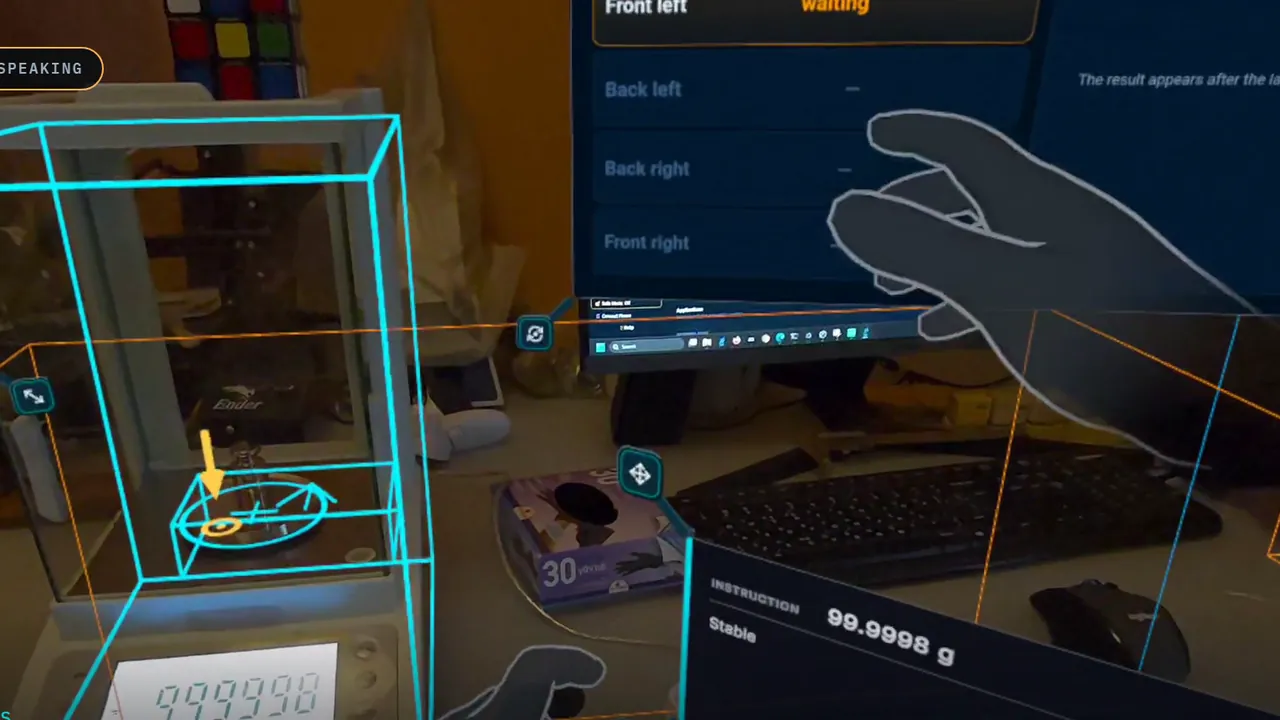
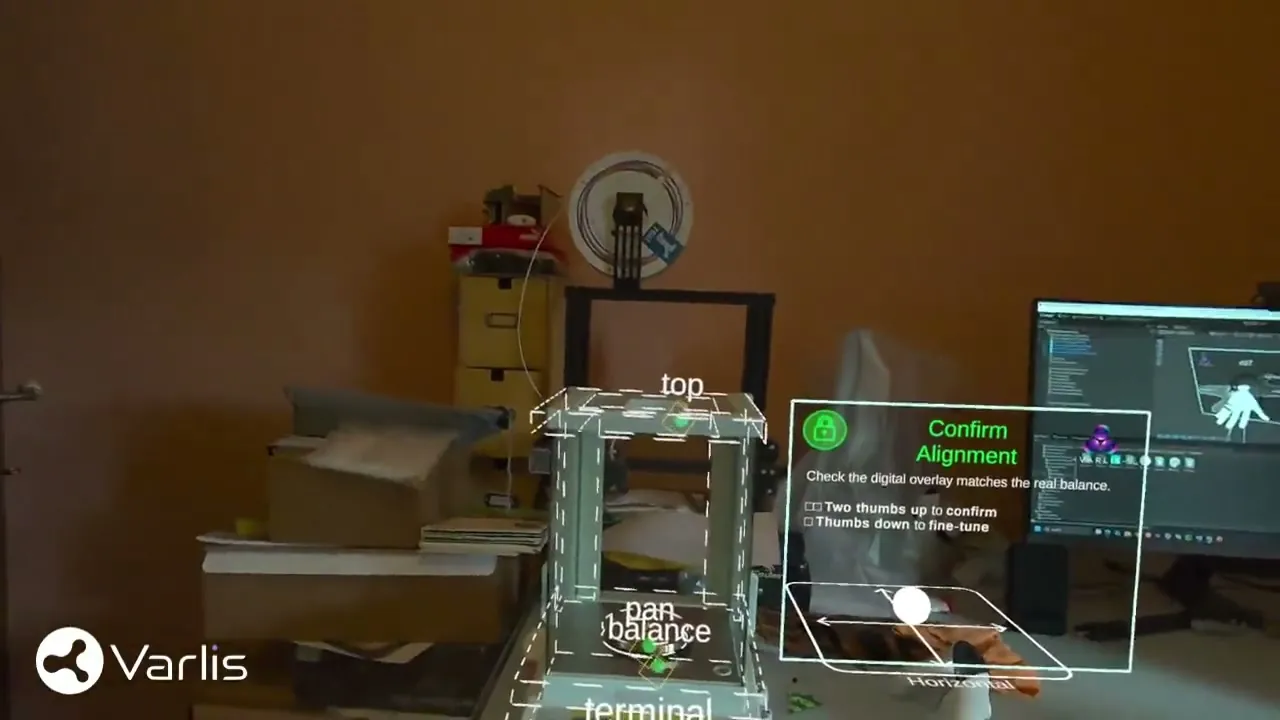
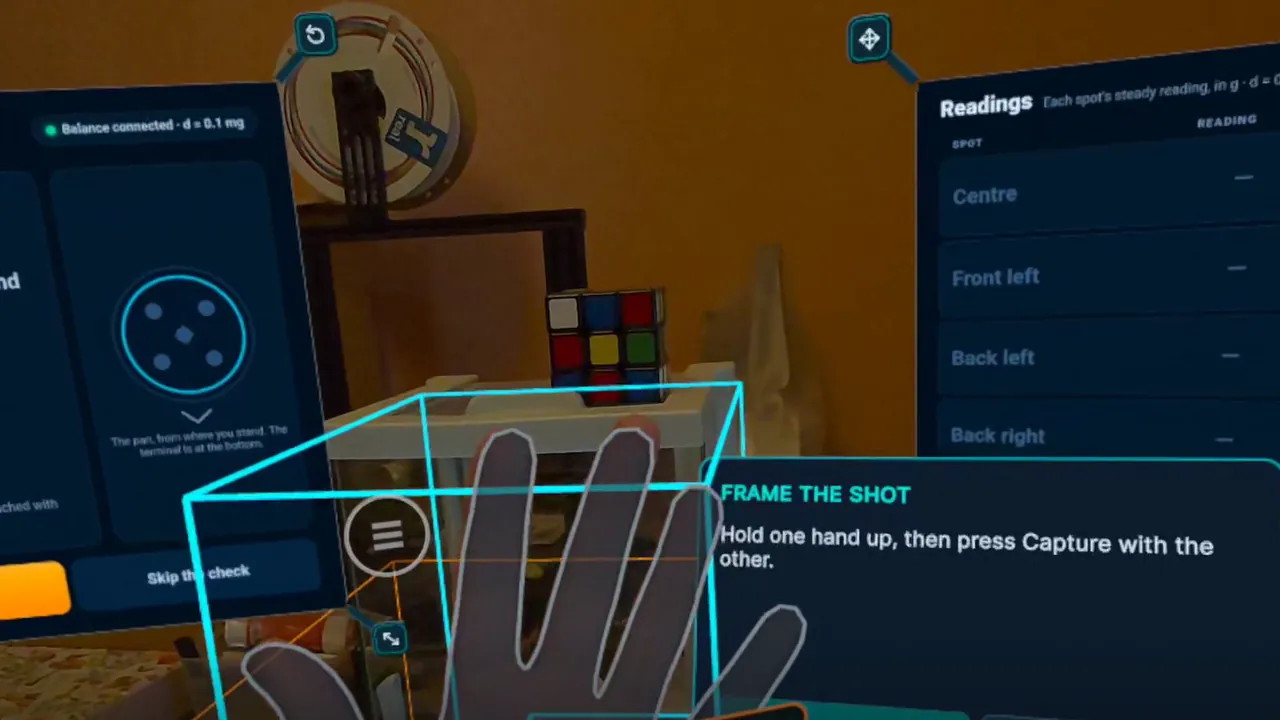
A guided eccentricity test on a real analytical balance, run in a headset with Alepou. The computer reads the balance itself over its serial port, and Claude checks the operator’s gloves and the final verdict.

Spatial AI in the lab: the recorded eccentricity test
Glove check: one photo of a hand
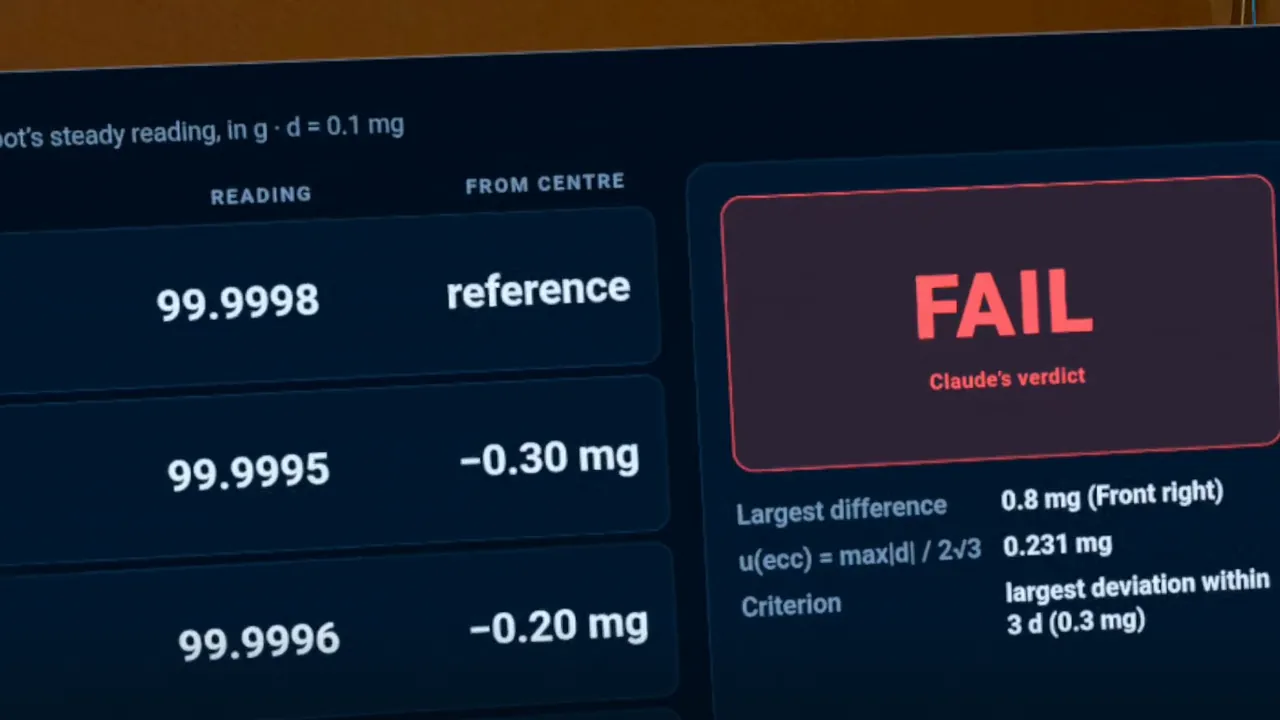
The readings and Claude’s verdict

How it works

  1. 1AskOne spoken request. Alepou asks before it starts anything on the PC, then starts the test’s workflow.
  2. 2FindOne photo of the balance. A vision model on the PC finds it and lands the outline on the pan.
  3. 3CheckOne photo of a hand. Claude holds the test until both hands are in nitrile gloves.
  4. 4WeighThe centre, then the four quarters of the pan. Each reading is taken by itself, once the balance is stable.
  5. 5DecideThe workflow works out the result against the limit. Claude checks the working and gives its own verdict.

What the film shows

One continuous take with a 100 g weight, edited for pace. The balance failed: front right read 0.8 mg below the centre, against a limit set strict on purpose at 0.3 mg, three times the readability. USP <1251> would allow 50 mg at this load.

Alepou

Spatial Agents

Agentic spatial AI

Demo page

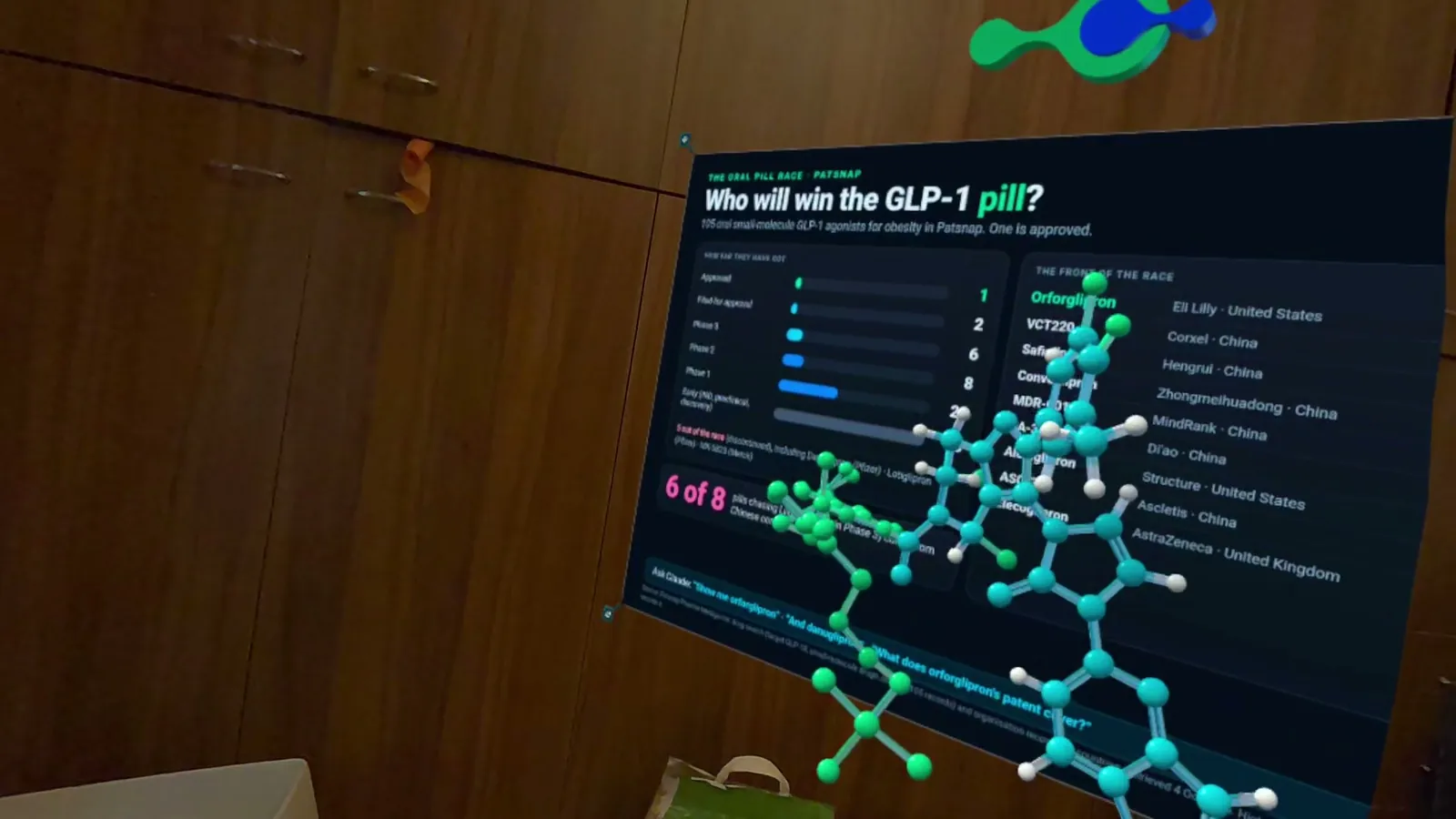
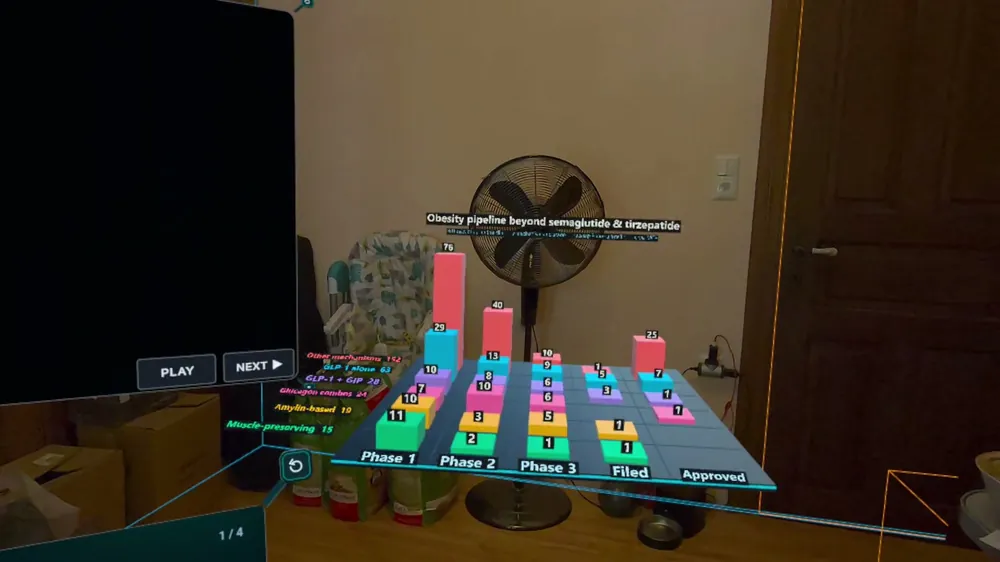
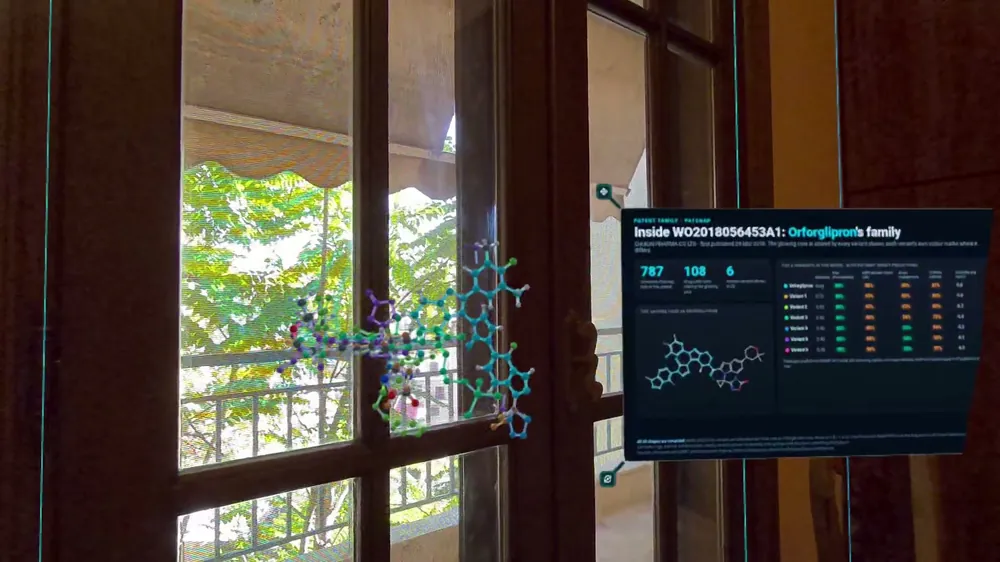
Ask a question out loud in the headset, and an AI agent queries enterprise life-science data and puts the answers in the room: a drug-pipeline chart, 3D molecules, a patent family. This was the first public demo of Alepou’s spatial mode.

Spatial Agents: the recorded headset demo
The obesity pipeline as a 3D chart
Patent family WO2018056453A1

How it works

  1. 1AskA spoken request in the headset reaches an AI agent working inside an Alepou project on the PC.
  2. 2QueryThe agent calls the provider’s MCP servers: drug, deal and patent intelligence, plus chemical structures and ADMET predictions.
  3. 3BuildProject tools turn the answers into pages, charts and 3D molecules. Every call, file and change is recorded in the project.
  4. 4PlaceAlepou checks each file and places it in the room. The headset simply shows it.

What the film shows

One take in the headset, about six minutes, lightly edited for pace. An independent demonstration on a commercial provider’s public life-science tools, not affiliated with or endorsed by the provider.

Alepou

Rubik’s Cube Solver

Built by asking

Watch on YouTube

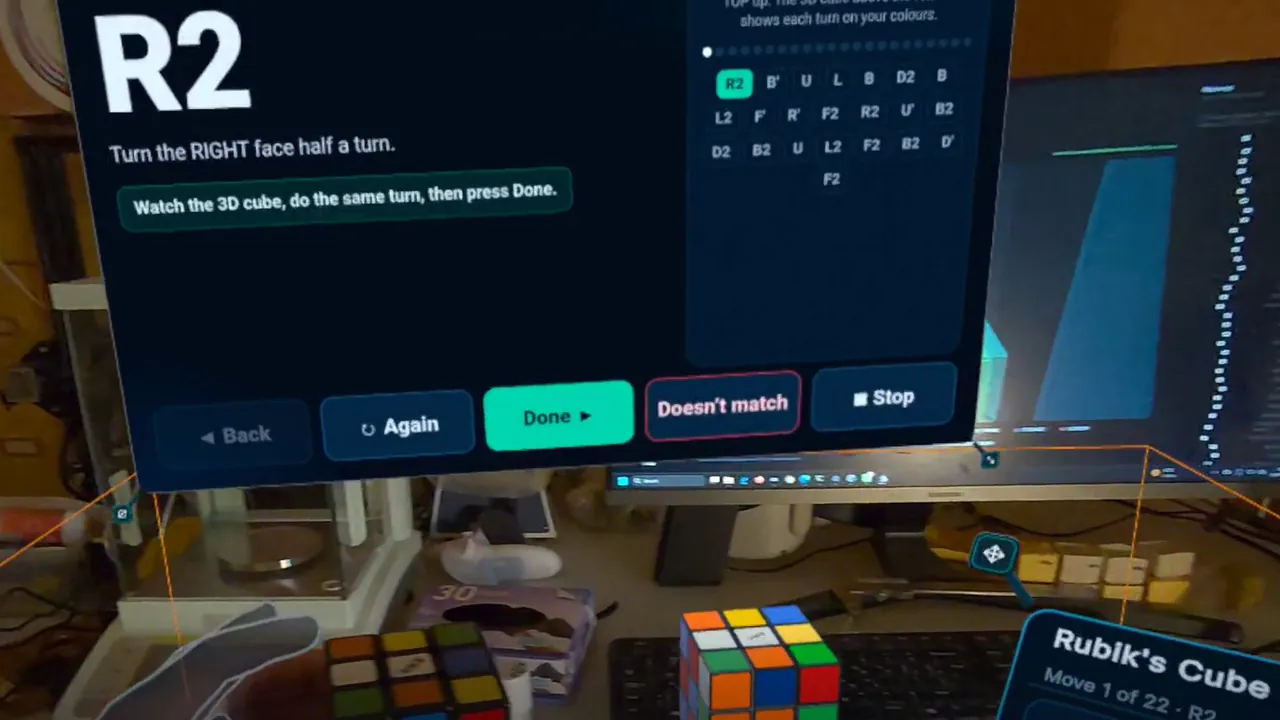
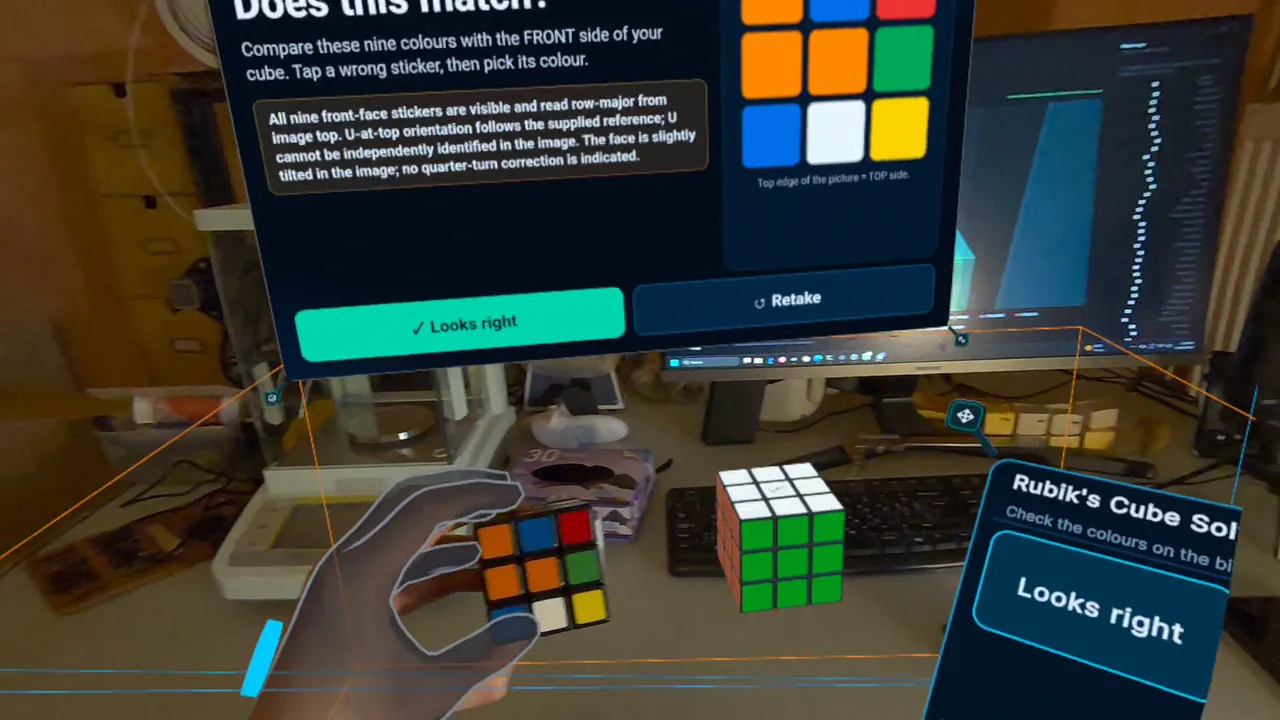
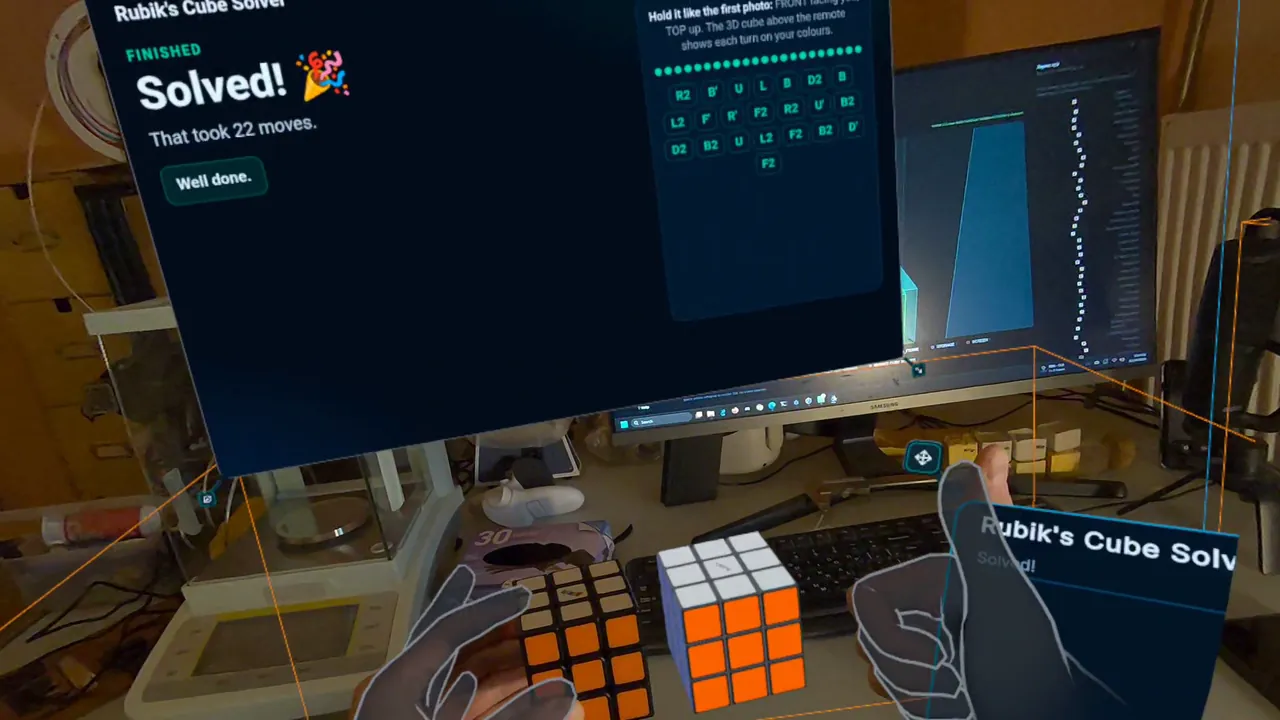
One spoken request, and the headset reads a real, scrambled cube from six photos, then guides it to solved one move at a time. The headset app has no cube in it: the workflow, its panels and the 3D cube were made by asking an AI.

Spatial AI, built by asking: a Rubik’s cube solved in a headset
Each face checked: Looks right, or fix a sticker
Solved in 22 moves

How it works

  1. 1AskOne spoken request. Claude opens the cube solver.
  2. 2PhotoOne photo per face. An AI reads its nine stickers; you check each face or tap a sticker to fix it.
  3. 3SolveThe cube is checked as real and solvable, and a solver on the PC finds 22 moves.
  4. 4TurnEach move plays on the 3D cube. Do the same turn, then press Done.

What the film shows

Edited for length from one continuous take on a Meta Quest 3. The cube model, its moves and the panels come from the workflow at run time; the headset app is the same one that ran the balance test.

Projects

Alepou

Universal client for wearables

alepou.ai

Ask for an app and an AI builds it, straight onto your headset. The headset runs one Alepou app that never changes; the AI, each app’s logic and the connections to real instruments run on your own computer.

Each film here was made that way, on the same headset app. Underneath is Alepou’s open-source workspace for long-running AI work, where every change is a task tied to a git commit, so the AI’s work stays inspectable.

Balance eccentricity testRecordedAbout this demo →
Life-science data agentsPublic demoAbout this demo →
Rubik’s cube solverRecordedAbout this demo →

How it works

HeadsetQuest 3 · one Alepou client app
  • Draws models, panels, pieces and worlds
  • Voice in and out
  • Hands, gaze and a remote
  • Camera photos on request
Your computerAlepou Desktop
  • The AI (Claude, also Codex), in sessions Alepou supervises
  • Writes each app as a folder of plain files
  • Runs each app’s logic: rules, scoring, steps
  • Perception: camera photos, object detection
  • Real instruments, such as a balance over serial
  • Blender and Unity, driven by the AI, for 3D assets
  • Speech, recording, audit trail
PhoneWatch and steer it all

Also built by asking

A 9×9 Go game played with pieces you pick up, a Japanese tea room with a cat, and the Mushroom March puzzle diorama. An HPLC pump-service walkthrough is in progress. Nothing about any of them is built into the headset app.

Projects

Project Parallax

Spatial computing

varlis.io/parallax

Mixed reality that recognises real laboratory equipment and guides the procedure around it.

Mixed-reality overlay registered to an analytical balance on a workbench
Passthrough capture, working prototype on Quest 3
Projects

Varlis VR Training

B2B VR training

varlis.io/training

B2B VR training software for scientific instruments and laboratory procedures. The first enterprise proof of concept was built for a global instrument manufacturer.

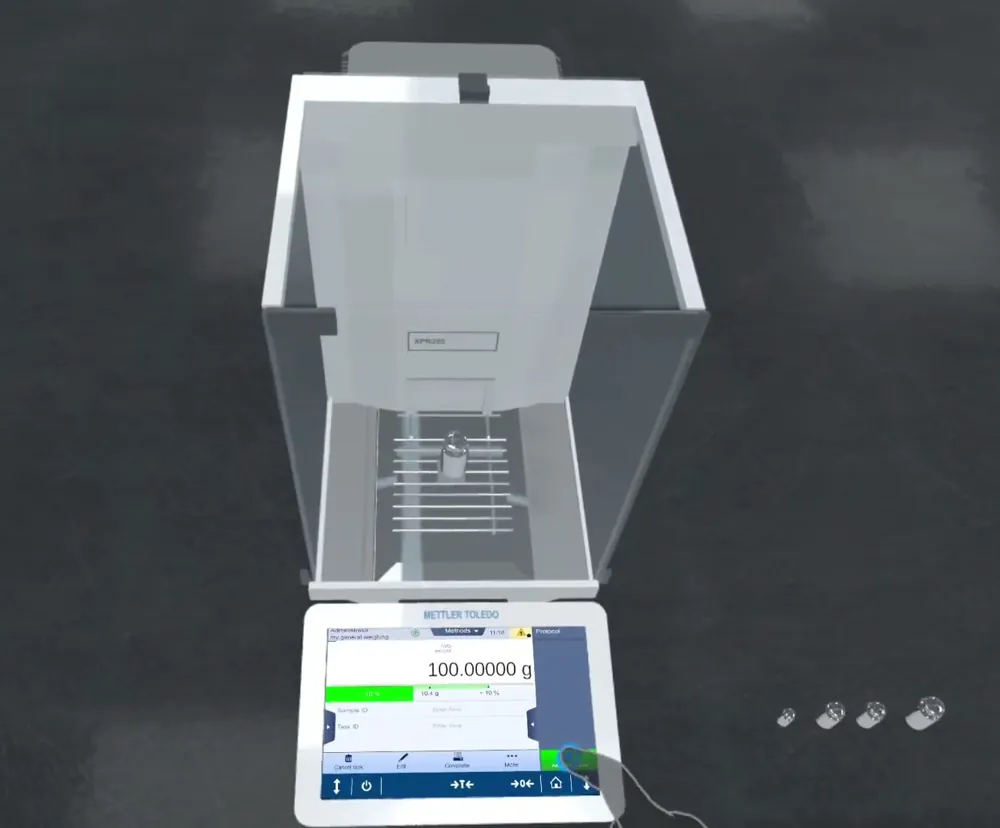
Virtual analytical balance with its touchscreen showing a weighing result
In-headset capture, calibration demo
Projects

Savans

Applied AI

savans.ai

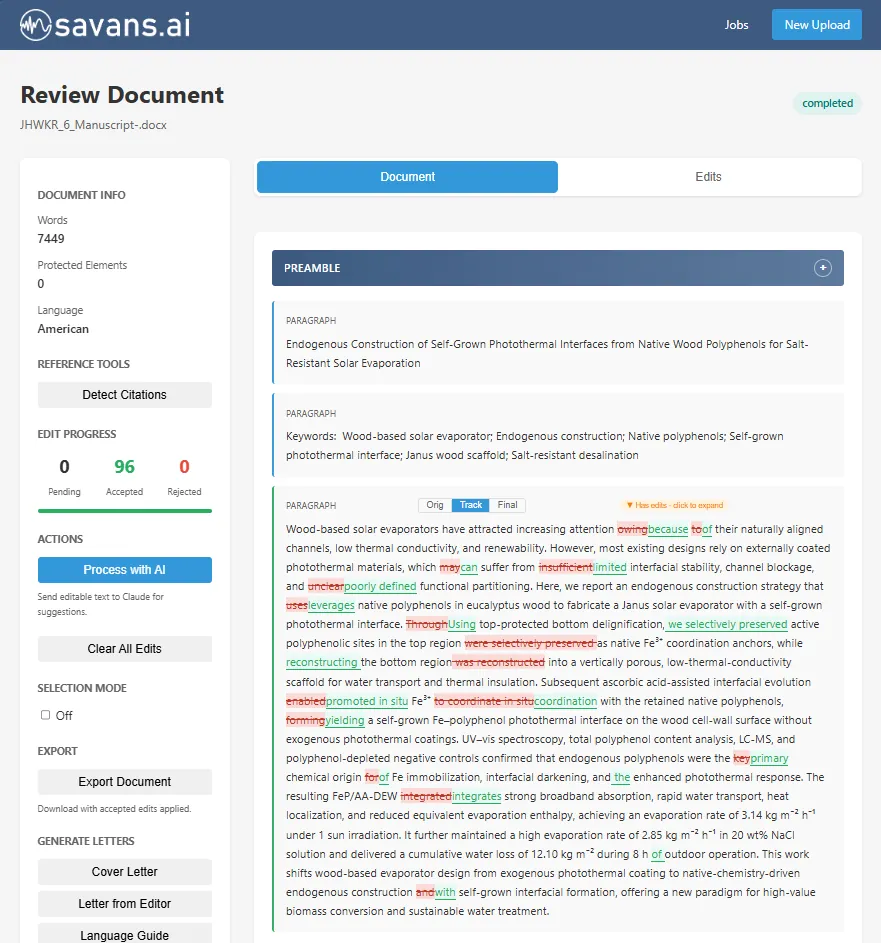
AI inside an editor’s existing Word and tracked-changes workflow, with a human reviewing every edit. Used in paid work.

Savans document review screen with suggested edits marked in the manuscript
Review screen
Projects

Spareleg

Side project · puzzle games

spareleg.com

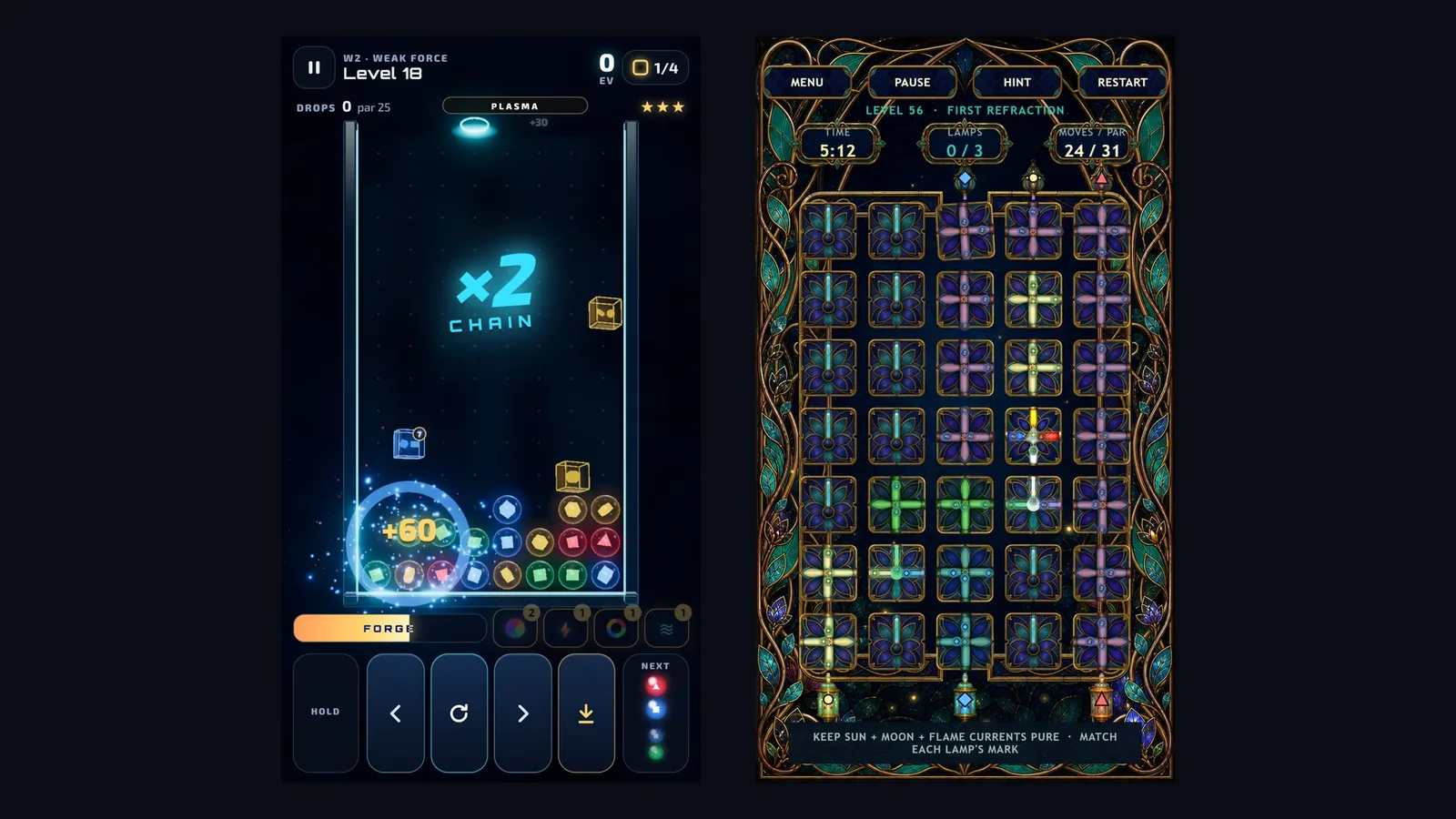
A side project: small science puzzle games. Quark Forge, a particle-physics colour puzzle, is out on Android; Firefly Relay is next.

Gameplay screens from Quark Forge and Firefly Relay side by side
Quark Forge and Firefly Relay, in-game captures

Science

Chemistry is where I learned to work: form a hypothesis, design the experiment, measure honestly. Industry then taught me how instruments, methods and laboratories behave when real people depend on them.

Applied in industry
  • Pharmaceutical QC and production laboratories
  • LC, LC-MS/MS and high-resolution MS
  • Analytical method development
  • Laboratory design and commissioning
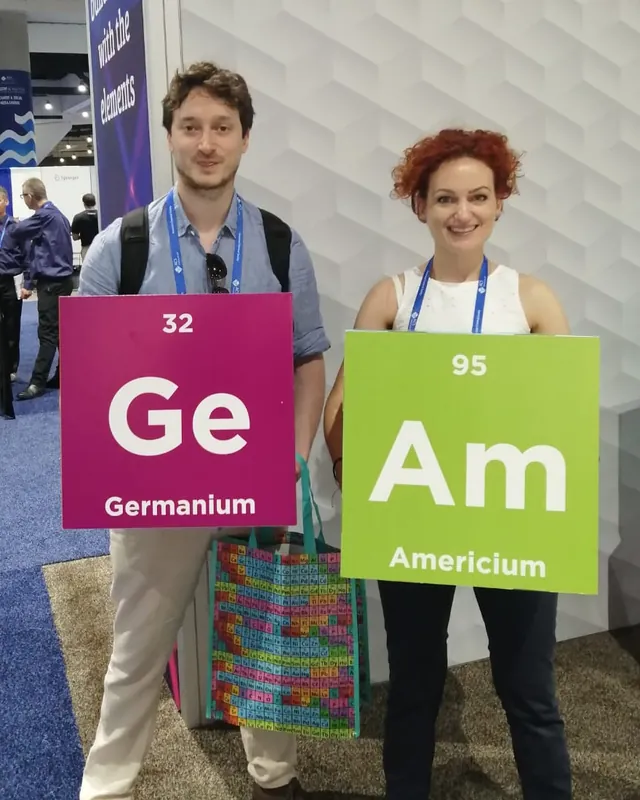
Guy Entract and a fellow chemist holding Germanium and Americium element boards at an American Chemical Society meeting
ACS National Meeting, 2019
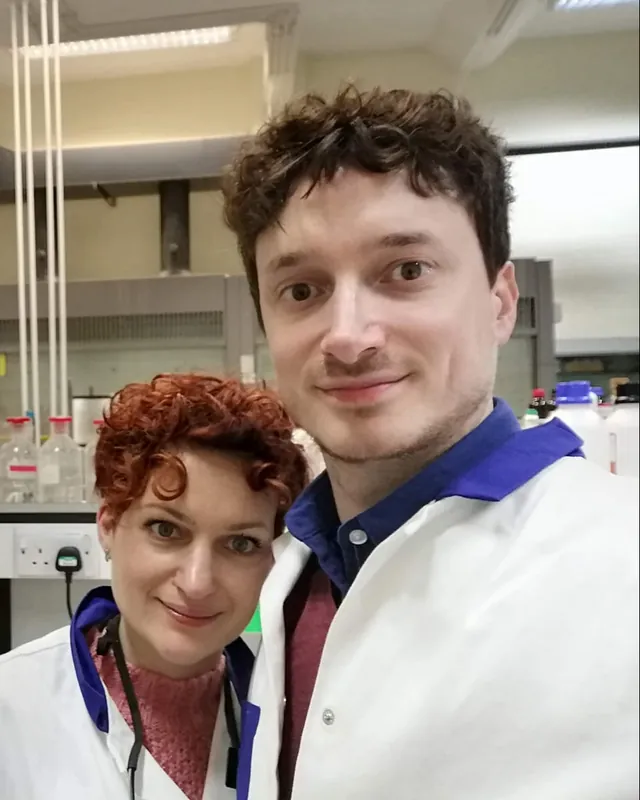
Guy Entract with a fellow chemist in a chemistry laboratory, fume hoods and reagent bottles behind them
In the lab, UK
Record5 entries
CodeEntryDetail
PhDPhD Chemistry, University of Hull, 2014–2019Molecular theranostics, photodynamic therapy, biological and organic chemistry.
PUBFirst-author paper, Molecular PharmaceuticsPeer-reviewed journal article from the PhD.
ACS ×2Two American Chemical Society National Meeting talksPresented doctoral research in San Diego and San Francisco.
PAT ×3Named inventor on three patent familiesSporopollenin microencapsulation: WO2022200762A1, WO2022180405A1, US20240139335A1.
EOFPharmacopoeial analytical methodDeveloped for a pharmaceutical manufacturer; accepted by Greece’s National Organization for Medicines.

About

I trained as a chemist at Hull, then spent a year and a half turning university research into patented products at a spinout. In 2020 we moved to Greece, and for three years I worked inside other people’s laboratories: installing and qualifying instruments, designing two pharmaceutical facilities from empty rooms and training the people who would run them.

That is where I learned what scientists need from technology, and how rarely software is built around it. Since 2024 I have been building it myself: AI agents that can be trusted with real work, and spatial software that sits beside real instruments.

Experience4

2024 – present

Varlis / Alepou

Founder & AI Product Builder

Thessaloniki, Greece / international

  • Own technical product work from open-ended problem and workflow discovery through solution definition, rapid build, evaluation, live demonstration, user feedback and iteration.
  • Built Alepou, a working agent-control environment with persistent context, governed tool use, structured tasks, recovery and audit; designed evaluation and acceptance tests and changed the product when evidence showed weaknesses.
  • Built a general-purpose wearable spatial runtime connected to Alepou and demonstrated it publicly with a commercial provider’s life-science tools: spoken requests become data queries, patent analysis, charts and 3D molecular views.
  • Built Savans around a real professional workflow and deployed it in paid work, keeping the user’s Word process and human review while materially increasing throughput.
  • Delivered a VR training proof of concept for a global instrument manufacturer, and Project Parallax, a mixed-reality system for guided workflows around real scientific equipment.

Sep 2021 – Nov 2024

Hellamco S.A. Scientific Instruments

Senior Applications & Support Specialist

Greece · universities, industrial laboratories, pharmaceutical manufacturing and QC

  • Worked directly with scientists, laboratory managers and operators, often on site, to uncover pain points and translate them into practical technical solutions.
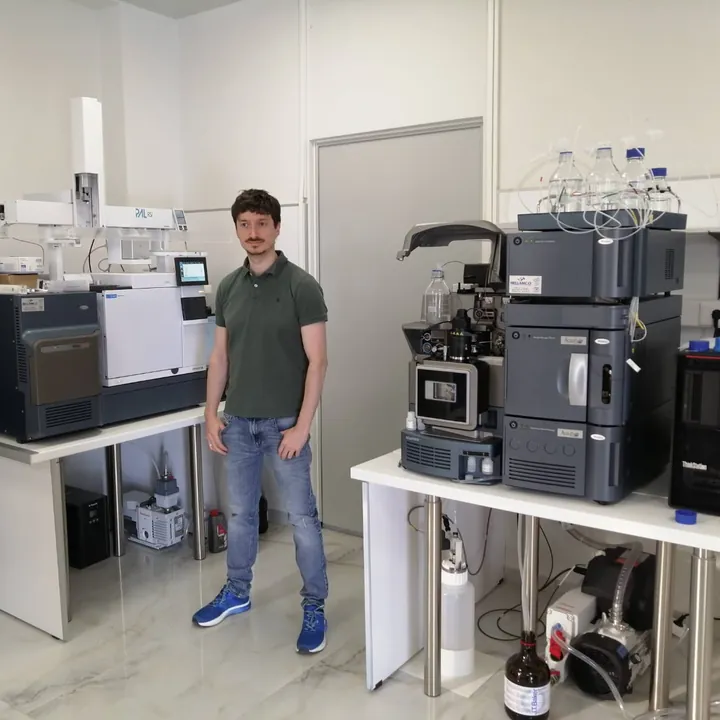
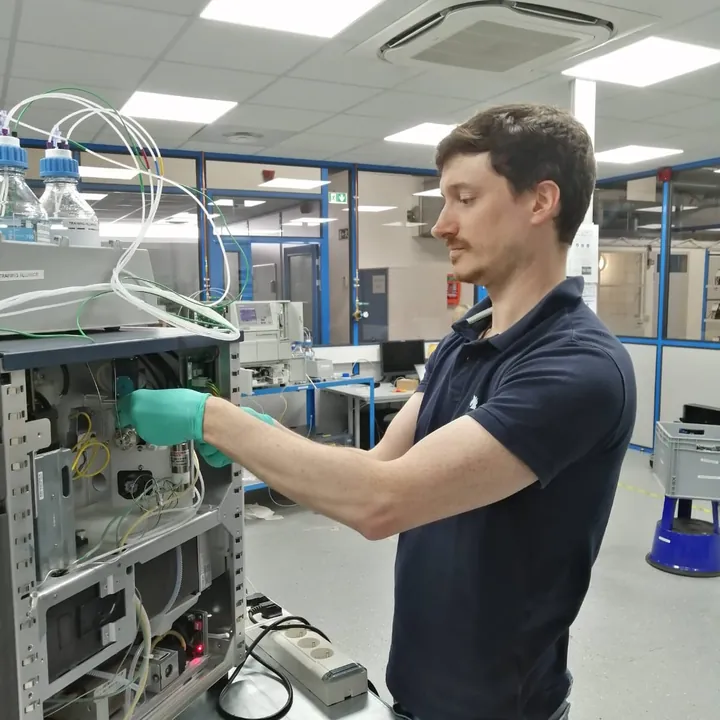
  • Applications specialist and service engineer at once, with about 30 weeks of manufacturer training from Waters, Mettler Toledo and Malvern Panalytical. Covered LC-MS and high-resolution MS, XRF/XRD, particle sizing, zeta potential and precision balances, and their software: method development, installation, troubleshooting and training.
  • Project-managed two new pharmaceutical facilities end to end as the lead contact, across QC laboratories and production areas: designed the labs down to power and water outlets, custom-designed the furniture, installed every instrument and ran IQ/OQ, then trained the staff.
  • Later brought back by a client as a consultant to develop a pharmacopoeial method accepted by Greece’s National Organization for Medicines (EOF).
  • Brought into complex sales and discovery meetings when scientific depth was needed; became authorised to lead technical sales in mining and trained sales colleagues on XRF and XRD.
  • Designed training for everyone from individual scientists to whole laboratory teams and internal sales staff, including lab-ready quick-reference guides.

Sep 2019 – Feb 2021

Sporomex Limited

Project Manager

United Kingdom · university spinout · sporopollenin microencapsulation

  • Designed and managed research-to-product projects, coordinating experiments and delivery across internal teams and academic, government and industry partners, working directly with the founder.
  • Developed new processes and applications contributing to three patent families as a named inventor.
  • Turned open scientific questions into structured programmes, balancing what the science could show with what the business needed next.

2014 – 2019

University of Hull

Doctoral researcher, PhD Chemistry

Hull, United Kingdom · before that, MChem Chemistry (2:1), 2009–2014

  • Self-directed research across porphyrin chemistry, PET/PDT theranostics and radiochemistry, including work with hospital radiotherapy physics on clinical irradiation equipment.
  • First-author paper in Molecular Pharmaceutics, talks at two American Chemical Society National Meetings and a poster at the Houses of Parliament.
  • Supervised MSc research projects every year and taught undergraduates weekly.